https://www.openpr.com/news/3994019/dental-floss-market-estimated-to-be-valued-at-usd-1-121-6-billion

There were American Indians, the Anacostans, living on Capitol Hill before the city was built - we need to commemorate that part of our history! See also: http://onceasitwasdc.org
Wednesday, April 30, 2025

Tuesday, January 23, 2024
New Contact with The NMAI
To establish a working rapport with the Natl Museum of the American Indian (NMAI), I've written to the current Director, Cynthia Chavez Lamar, offering my help in creating online programming about the Anacostan and Native History of DC.
In a comment on the letter, Chief Swann of the Piscataway-Conoy Tribe emphasized that the programming should include the living Piscataways, not just their history. I fully agree, and if I'm called on to work on a website addition, the modern Piscataways will certainly be included!
Here's a copy of the letter:
Dr. Cynthia Chavez Lamar
Director, National Museum of the American Indian
January 18, 2024
Dear Dr. Lamar,
Best wishes for 2024! I'm writing to introduce myself and offer any help I might provide so the NMAI would include information on the Native history of Washington, DC, especially the Anacostan/Piscataway people who once walked the land where the NMAI now stands.
In the fall of 2023 I published "Native American History of Washington, DC," (Arcadia Press). In the book I include an account of my efforts since 2016 to encourage the NMAI to address local Native history.* It was in 2016 that I became aware of the Native village that had been identified in the late 1800s on a site less than a 1/2 mile from the NMAI (Garfield Park/Carroll Estate). Since that time I've collected the history of nearly 20 other sites in Washington, DC. They are discussed in detail in my book, and more generally in an interactive map on this website: http://onceasitwasdc.org/.
I would be happy to meet with you, or members of your staff, to discuss how this topic might be added to the public materials of the NMAI. I suspect the most feasible and cost effective format would be as an online exhibit.
Sincerely yours,
Armand
Armand Lione, Ph.D.
Director, DC Native History Project
202.487.7092
http://onceasitwasdc.org/
*My previous correspondence with Kevin Gover can be found on this website: https://nativevillagemarker.blogspot.com/
Monday, January 22, 2024
City Ridge Presentation on Native American History of DC Book, Jan 30, 6p.
I'll be doing a presentation about my book at the City Ridge Apts, in Tenleytown, on Tues. Jan. 30, 2024, 6pm. It's free and open to the public.
Here are the details on how you can register and attend:
Friday, November 24, 2023
Native American Heritage Day 2023 - The Hidden Native Artifacts Found at the White House
For Native American Heritage Day 2023, this video tells the story of the Native artifacts found on the grounds of the White House and what we need to do to get them displayed publically.
https://youtu.be/oFEJ9SoR2eM

Thursday, November 16, 2023
New working link for "Manahatta to Manhattan"
Friend of the DCNHP, Tony Scialli, brought to my attention that the play "Manahatta" opened today in NYC. Perhaps more about that in the future, after Tony sees the play in December, but this note got me to look at the story I tell in Native History of Washington, DC:(p.120) (see text below).
When I checked the online link for the pdf of "Manahatta to Manhattan," I found it had been changed. The new working link is: ManahattaFINAL.indd (ospi.k12.wa.us)
Here's how the strange story is told in the book -
"In 2018, I came across a publication of the NMAI, which has a museum
in New York City as well as Washington. The article that I found online was
“Manahatta to Manhattan,” an excellent retelling of the Native American
people of the Lenape tribe who once lived in Manhattan. In a letter I
wrote to Kevin Grover on October 15, 2018, I cited that document on the
Manahatta and pointed out that it contrasts sharply with the absence of a
similar story about the Native tribe of Washington, DC.142 Oddly, when I
later went back to look for the Manahatta document, I found it was no longer
available on the website of the NMAI. It can still be viewed online from a
website in Washington State."

Monday, October 9, 2023
Indigenous People's Day Oct 9, 2023
To mark Indigenous People's Day 2023, here's the Land Acknowledgment for DC that was put together in 2019 with input from Chief Jesse James Swann of the Piscataway Conoy Tribe:
We acknowledge that this is the traditional land of the Anacostan People of the Piscataway Tribe.

Monday, September 4, 2023
"Native American History of Washington, DC" Book Release, Sept. 4, 2023!
This book is the cullmination of what started with my earliest efforts to get a Native Village Marker for Capitol Hill!
Hopefully, telling the whole story of my collection of details on the Garfield Park/Carroll Estate site, and the many others around the city, will significantly increase awareness of the many missing stories in the Native history of DC!

Wednesday, June 14, 2023
Statement by Matriarch Julie Tayac Yates to Accompany Plaques Marking the Restoration of Piscataway Fishing Rights in Washington, DC
Following the ceremony that was held on Oct. 15, 2022, DOEE produced a set of ceremonial plaques to memorialize issuing the first licenses to restore native fishing rights in the waters of the District of Columbia. DOEE collaborated with Matriarch Julie Tayac Yates of the Piscataway Indian Nation and Chief Jesse James Swann, Jr. of the Piscataway Conoy Tribe to design their respective ceremonial plaques as a gift from DOEE to commemorate the historic occasion.
Chief Swann issued a statement to accompany the Piscataway Conoy Tribe plaque that can be read at this link: https://www.
Matriarch Tayac Yates issued a statement to accompany the Piscataway Indian Nation plaque that is posted here:
Under this mulberry tree on April 10, 1666, Leonard Calvert made a treaty with the Indians of the Village.
Today, past and present, we are recognized with our traditions, and identities, we continue to
preserve our historical heritage.
In memory of Chief Turkey Tayac
27th Hereditary Sagamore, Piscataway Indian Nation
1895-1978
Memewatt,
Matriarch Julie Tayac Yates
Dr. Gabrielle Tayac
Today, past and present, we are recognized with our traditions, and identities, we continue to
preserve our historical heritage.
In memory of Chief Turkey Tayac
27th Hereditary Sagamore, Piscataway Indian Nation
1895-1978
Memewatt,
Matriarch Julie Tayac Yates
Dr. Gabrielle Tayac
Note: Matriarch Tayac Yates' statement references the second image of the "Old Mulberry" tree on this page.
The DC Native History Project is proud to be among the groups receiving copies of the ceremonial plaques and both of the posted statements!
Friday, April 28, 2023
In the 1666 Treaty, "Anacostanck" Was Used As the Tribe Name, Nacotchtank Was Not Mentioned.
This previous post from Feb 2022 discusses how the prominent error made on Captain John Smith's 1612 map still confuses many modern investigators about the name of the tribe of Native Americans who once lived in and around Washington, DC.
The map makers misheard the words used for the name of the tribe and wrote the name of "Nacotchtanck" on the 1612 map. The name for the tribe was derived from the Native words for "a town of traders." As was pointed out about 20 years later, by Father Andrew White, the Jesuit who studied the Piscataway language for his preaching, the word for trading was "anaquash" and town was "tanik," so Anaquashtanik was what the mapmakers recorded as "Nacotchtanck."

Native names, like many foreign names, went through a lot of changes as they were used by English settlers. But as evidence of how quickly the tribe name moved away from the Nacotchtanck form, the name used for the tribe in the Peace and Amity treaty of 1666 was "Anacostanck." (In a previous version of this post, a reading of the name as "Anacostaub" was included. Searching the transciption given in the Maryland Achives link that follows, it seems that the apparent "ub" ending is an old script for "ck.")

Here's a link for the full text of the treaty. The name "Nacotchtank" or it's derivations isn't in the treaty.
Currently, Wikipedia still has an entry for "Nacotchtank." Their entry on the 1666 treaty says the name of the tribe was "Anacostanck," which is an active link to their Nacotchtank entry. Despite previous attempts, getting the cabal that controls the content of the entry to change the discussion of the name and several other confusions in the text, little or no progress has been made. Maybe pointing out the absence of Nacotchtank in this 17th century legal document will move an editor to correct the explanation of the Anacostan tribe's name.
Wednesday, January 18, 2023
You Are On Native Land t-shirt
My old friend, Doug Hartnett, was kind enough to give me this excellent "YAONL" t-shirt:

It can be ordered from this Native American website:
but if you're like Doug (and me), you might want one with larger text.
There are several other online sites that also sell the shirt, many with the larger text, shown here.
Preach on!
Friday, December 2, 2022
DC Public Library Podcast for Native American Heritage Month
DCPL Podcast on DC Native Artifacts
In honor of NAHM, Ryan Williams, Digital Producer for DCPL, hosted a podcast with Ruth Trocolli, the State Archaeologist of Washington, DC, Chief Jesse James Swann of the Piscataway Conoy Tribe, and me, to talk about the Native artifacts that the Office of Historic Preservation now stores at the MLK building. In the podcast we discuss some of the many locations, including the White House, where Native artifacts have been found in the city, and Chief Swann shares the perspective of what the artifacts mean to the local Piscataways, who are the descendents of the artifact creators.

Tuesday, November 22, 2022
Native American Heritage Day 2022 Video - The Restoration of Native Fishing Rights by Washington, DC!
A 1666 Treaty between the colonists and the Piscataway and Anacostan tribes, among others, stated:
"The priviledge of hunting Crabbing fishing & fowleing shall be preserved to the Indians inviolably.”
When members of the DC City Council learned about this treaty, they passed a bill giving local Natives free fishing licenses. The first licenses were presented at a ceremony on Oct. 15, 2022.
This 2.20 min video tells the details of that story, in honor of Native American Heritage Day, 2022!
Fishing Bill video NAHD 2022: https://youtu.be/HKgNskifpQg

Wednesday, June 1, 2022
The Native Storage Pits Found at Fletcher's Boathouse in 1997
Archaeology done at Fletcher's Boathouse in 1997, before some parking lot construction, located more than 11 large Native storage pits. They seem to have been dug sequentially at roughly the same time, more than 2000 years ago. One theory for their use was that Natives travelling upriver, got to the falls on the Potomac, and stored their excess goods in the pits, before portaging their canoes upstream.
Yet another fascinating piece of DC Native History that goes untold at Fletchers and elsewhere in the city!
The Washington Post ran a story about the site:
"Mysterious Silos Found Next To C&O Canal, Underground Pits are 2000 Years Old." Linda Wheeler. Washington Post, Nov. 1, 1998, pg. B6.. (Full text available through DC Public Library and other public libraries.)

Archaeological dig at Fletcher’s Boathouse, 1997. Courtesy of Richard Teehan/Friends of Fletcher’s Cove.org.

Diagram of pit outlines redrawn from original report.
Sunday, February 27, 2022
The Name of DC's Native Tribe – How “Anacostan” Grew Out of the Original Mistake, “Nacotchtanck.”
In the summer of 1608, when Captain John Smith and his mapmakers sailed up the Potomac to the area where Bolling Airforce Base now sits, they labeled the Piscataway tribe they found there, “Nacotchtanck.”
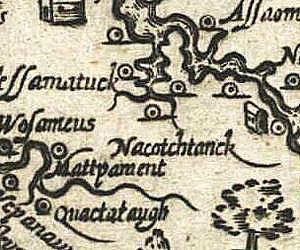
The proximity of this tribe to the confluence of a second river that joined with the Potomac (now “The Anacostia”) put them in a choice location to be traders, and the name Nacotchtanck was meant to mean “a town of traders.”
Within 20 years of the publication of Smith's map, Father Andrew White, who came to the colonies in 1634 to convert the Natives along the Potomac, changed the name used for the tribe of traders by adding an “a” sound to beginning of the name. This led to a number of variations for the name among the other English settlers, but one of the most popular derivative forms became “Anacostan.”
White studied the Piscataway dialect of the Algonquin language, so he could preach in their native language. He noticed, as have other commentators after him (Burr, 1920; Tooker, 1894), that the word for “a town of traders,” would be "anaquashatanik" which is based on the Algonquin words, “anaquash,” meaning "to trade," and "tanik," indicating a town.
Public interest in the Native tribe of DC often starts with reference to Captain Smith's 1608 map, and it isn't hard to find citations online with the name “Nacotchtanck,” or a variation of that name, including the entry on Wikipedia (2022).
The current Wikipedia description of the origin of the Anacostan name seems to come from this statement by James Mooney in an important collection of 1899 articles on the First People of DC (Mooney, 1899):
"Nacochtank, which was the residence of a chief and contained eighty warriors, was the principal settlement within or adjoining the District. The Jesuits, who came out later with Lord Baltimore, latinized the name as Anacostan, ..." p. 260.
Mooney's linguistic studies involved the Native languages of the Southwest, not Piscataway or other Algonquin languages. The one Jesuit who changed the name was Andrew White, described above. "Latinizing" the name was not his goal. In 1920, Burr gave a description of the origin of the name consistent with the Algonquin "town of traders" phrase "anaquash - tanik," made by Fr. Andrew White (Burr, 1920).
The 1894 article by Tooker, cited above, points out that Captain Smith never used the spelling from his map when he wrote about the tribe. He did use 5 other names: Nacotchtanke, Nacothtank, Nacotchtant, Nacotchtanks, and Necosts (Tooker, p. 391).
The error in the original name isn't surprising, since Algonquin languages do not have an alphabet, Smith's mapmakers couldn't just ask “how do you spell that?” Variations on the names of Native tribes are common. A 1787 document on the transcription of Native languages by English settlers includes a comment “almost every man who writes Indian words, spells them in a peculiar manner…” (Edwards, 1787).
The Native Americans weren't the only group who got their names mangled by local English speakers. For example, the Amish people who migrated from Germany and settled in Pennsylvania would have told English speakers they were “Deutsch.” Now, the Amish are commonly referred to as the “Pennsylvania Dutch.”
Since the name “Anacostia” refers to a major neighborhood and river in Washington, DC, referring to its Native tribe as the Anacostans (Tayac, 2004) pulls together these names, and helps listeners understand their association.
Bottom line: Forget the map name! Remember the Anacostans!
References
Burr,
Charles R. (1920). "A
Brief History of Anacostia, Its Name, Origin and Progress". Records
of the Columbia Historical Society, Washington, D.C. 23:
168.
Jonathan Edwards, Observations of the
Language OF the Muhhekaneew Indians. Communicated to the Connecticut
Society of Arts and Sciences (New Haven: Josiah Meigs, 1787
Mooney, James. “INDIAN TRIBES OF THE DISTRICT OF COLUMBIA.”. p. 259-266.
In "The Aborigines of the District of Columbia and the Lower
Potomac - A Symposium, under the Direction of the Vice President of Section D." American
Anthropologist 2, no. 3 (1889): 225-68. http://www.jstor.org/stable/658373.
Tayac, G. 2004. Keeping the Original Instructions. In Native Universe: Voices of Indian America, McMaster G, ed. p. 77-8.
Tooker, WW. On the Meaning of the name Anacostia. Am Anthrop., os VII, 1894, pp. 389-83.
Wikipedia. Nacotchtank. November 2022. https://en.wikipedia.org/wiki/Nacotchtank
(note: The wiki spelling is not the same as seen on the map. Anacostine is a variation of Anacostan, with an added “i”, which does not occur in any of the original forms of the name.)
Wednesday, January 5, 2022
Proudfit's 2nd Native Village - On the grounds of the US National Arboretum (Details!)
This is the portion of the 1973 application of the US National Arboretum for status as a National Historic Place:

In 1934 a Civilian Conservation Corps camp was built at what was 28th & M Sts, which sat between what is now the lower Arboretum and the top of the Langston Golf Course. It was during their work that the artifacts mentioned above were found. Contacting DC Historic Preservation to locate those artifacts is an upcoming project!
This DC Historic sites page for the USNA also mentions the Piscataway, which would be the Anacostans:
“Most of the original, centuries-old forested landscape of the arboretum remains preserved, and evidence indicates that in past centuries the land housed Piscataway Native American habitations and, later, 19th century spring houses.”
The site in the Arboretum is about 1 mile from the Benning area on the east side of the Anacostia, where Proudfit did a lot of his collecting. It's reasonable to speculate that he did some searching on the west side of the Anacostia and found an assortment of artifacts that indicated a Native village on what is now Hickey Hill in the US National Arboretum.

So this is another piece of DC Native History that has been available to the public for more than 50 years, but just not discussed.
I'll be contacting the US National Arboretum to see if we can get a public showing for the artifacts and the story of the Anacostans who once lived there.
To be continued...
Monday, December 6, 2021
Proudfit Identified 2 Native Village Sites Inside DC - The 2nd Seems to Be Located on the Grounds of The US National Arboretum
In his 1899 article on Ancient Village Sites in Washington, DC, SV Proudfit said there were 2 sites. One was on the former Carroll Estate, the second "southeast of the Reform School on the Ancostia."


During the last week, I've been trying to contact the person at the Arboretum, which is part of the Dept of Agriculture, who is responsible for the archaeology done there.

Here's how he marked it on his map:

Based on the topographic maps from the late 1800s, there was a hill, Hickey Hill, around that spot.

Over the years, the land in that area was farmed in various spots, but largely undeveloped until it was bought in the 1920s to create the US. National Arboretum.
Here's how the area from thia 1890s map corresponds to the current map of the US. National Arb.

More details when I get them!
Saturday, November 27, 2021
NAHD 2021 Video: Where in Washington, DC Can You Learn about the History of its Native People, the Anacostans?
As a status report on the Native history of the Anacostans in DC, here is a 6 min. video that summarizes sites that exist in 2021. If any readers know of others, please be in touch!
Video link: https://youtu.be/WMA-fpiWUIo
Sorry to say, Maggie, but 100 years later, this is still true!

Monday, November 22, 2021
Recent and Upcoming Happenings
This blog has gotten a bit neglected recently. The FB DCNHP page seems to
attract more attention. But this is a great place to do a liesurely summary of
what has been happening and may happen regarding the Native history of DC!
- Chasing after Bolling for the last 2 years may eventually pay off! A friend
found an ad on an antropology website that they're trying to hire a person with
an archaeology background for the air bases in the DC area and part of their
work will involve dealing with Native American issues!
- On Dec. 1, Piscataway
leaders will be meeting with the DC Water people to hear their plans to
incorporate Native history into the materials they produce for the public and
mark some of their sites to include Native history (they have properties near
Bolling AFB and Soapstone Valley). \\
- An effort to expand the name of Garfield
Park to Garfield-Anacostan Park is being presented to the Advisory Neighborhood
Commissioners in Dec (or maybe Jan.) A member of Charles Allen's staff has
offered support in presenting a successful vote by the ANC to the full City
Council!
- The Sept. Washington Post article led to a number of additional
presentations about the "Hidden Native History of DC," including a few high
schools, an Oasis group based in Bethesda, and the Art Club of Washington.
 Coming soon! A video for Native American Heritage Day on the status of where you
can find some public mention of the Ancostans in 2021 DC.
Coming soon! A video for Native American Heritage Day on the status of where you
can find some public mention of the Ancostans in 2021 DC.

Wednesday, September 15, 2021

Monday, August 16, 2021
Garfield Park Native History Day 2021
Saturday, Aug. 21, 2021, we will host our second Garfield Park Native History
Day!
This year will include the documented archaeology of the Carroll Estate
that adjoins the park, and the finds made when the park was built -
we will also describe the new finds that have been made nearby since our last event in
Garfield Park in 2019.
Here are the flyer (excellently designed by Ben Aronson) and a press release for the day.


Subscribe to:
Posts (Atom)